Passion for Precision

Wednesday, April 10, 2013

YEAR 1970: APOLLO 13 EXPLOSION. YEAR 2013: APOLLO 13 DIECAST FROM BANDAI


Bandai from Japan has pulled out all the stops with this 1:144 scale ready-built model, featuring the various components of the nearly-disastrous Apollo 13 space mission of 1970.

The Bandai 1:144 scale miniature is little short of astonishing. Every last detail seems to have been incorporated, from the damaged Service Module (SM) to a mini-diorama that features a floating Command Module (CM), a pair of divers with flotation collar, and a Sikorsky S-61 helicopter.


Stage treatment
The Saturn V is nicely detailed and coloured. We particularly like the treatment of the tanks within the main stage cylinders.


Stacked for launch
The whole Apollo assemblage can be displayed stacked and ready for flight, or you can separate the various parts into sections. For the latter, Bandai provides a set of mounts so the various Saturn V stages have no chance to roll away. The vertical display option has a base with transparent support arms, looking somewhat like the system used for real-life Russian Soyuz launchers. In launch configuration, the 1:144 scale Saturn V stands some 768mm (30.25in) high, plus display plinth.


Care and attention
We’ll let the pictures do most of the talking from here on, as you need to look and admire the care and attention that Bandai’s product engineers have put into this Apollo 13 model.


About Apollo 13
Apollo 13 was the seventh US manned Moon mission, and the third intended to land on the surface. The huge Saturn V launcher blasted off safely on April 11, 1970, at 13:13 CST from the Kennedy Space Center, Florida, but two days later an oxygen tank in the Service Module exploded, crippling the spacecraft.


Deadly danger
The lunar landing part of the Apollo 13 mission was aborted, the issue becoming one of getting the crew back to Earth safely. Despite problems caused by limited power, loss of cabin heat, shortage of drinking water, and the need to carry out makeshift repairs to the carbon dioxide removal system, the Command Module and crew splashed down safely in the Atlantic Ocean five days later, on April 17.


Summation
An excellent ready-built that is the last word on Apollo 13 at 1:144 scale. Right then, Bandai - what are the chances for a giant-sized 1:72 version?! The Bandai Apollo 13 to 1:144 scale is available from July 2013.


You can pre-order this and also Apollo 11 to the same scale from suppliers such as Hobby Link Japan.

Interesting space stuff from Bandai and others here.


Monday, April 8, 2013

INCOMING: 1:48 SCALE SUPERMARINE SPITFIRE PR XIX FROM AIRFIX


A new-tool kit from Airfix that features one of the fastest and most graceful Spitfire versions made, powered by a Griffon engine.


The PR XIX was the last photo-reconnaissance Spitfire flown in active RAF service. Produced by mating features of the MK XI with the Griffon engine of the XIV, the PR XIX was one of the fastest Spits, which was just as well, as it had no armament, instead relying on speed and agility to keep clear of enemy aircraft.


Bagged components
This new-tool 1:48 scale Airfix Spitfire comes in the now-standard presentation box, with handsome artwork on the top. The 98 components are presented on three main runners, plus a separate bag for the transparent parts, most useful, as this prevents these delicate items from scratches in transit. Also supplied are decals and instructions.

Healthy pilot
Panel lines might look a shade on the heavy side, but they seem accurate and will fill in when painted, so no problems there. The cockpit is well-detailed and the pilot figure nicely sculpted too. Give this aviator some careful treatment and he will look very realistic indeed. Pleasingly, he appears to be about the right size and has obviously eaten well before takeoff, no perhaps this kit finally lays to rest the long-remembered ghost of the malnourished and shrunken Airfix aviator. He can sit inside a closed or open canopy, though it does not slide.


Cameras aboard
This is a photo-recon version, so Airfix has supplied the vital cameras. They will be near-invisible when the model is finished though, and you do need to make a choice whether to have the various airframe panels closed or not. Open them up, and the model will start to look really convincing.

Powerful engine
The PR XIX has a very busy appearance upfront, as the big Griffon engine had five prop blades, and these are modelled neatly enough, as a one-piece moulding. For this modeller that’s fine, as there is no opportunity to misalign the angle of the separate blades. The engine exhaust ends need to be opened up very carefully though, for without some effort here, the pipes end in blank stubs.

Build options
Ailerons, flaps, and landing gear all have options, and not forgetting that the PR XIX had a retractable tailwheel, Airfix offers either the tailwheel with open doors, or supplies a separate, single component for the flush-fit doors when cleaned up for flight. Like the single-piece propeller, the lower wing offers the same useful ‘can’t get it wrong’ approach to getting the wing dihedral correct, a very sensible decision from the kit’s designers. When assembled the Airfix PR XIX Spit has a wingspan of 235mm (9.25in) and length of 213mm (8.4in).

Decal scheme
Airfix offers two options, 'The Last!' from No 81 Squadron, based at RAF Seletar, Singapore, as flown on All Fool’s Day, 1954. The other scheme is an unusual choice, being a Swedish Air Force machine, as flown in 1955. The Airfix Spit ought to look very good if built sporting Sweden’s handsome blue and gold roundels. The thin decal sheet is a quality item, with precise printing and with plenty of tiny stencil warnings on it, just right for adding that’s operational look, and as it’s to 1:48 scale the model can easily handle this level of detail; you wouldn’t bother at 1:72 scale.

Summation
Good news for Spitfire fans - a good kit that’ll please anyone, from beginner to expert. Decals choice unusual and desirable.

Squadrons of Airfix Spitfires available here.

Friday, April 5, 2013

A TALE OF THREE BOXES


MAT IRVINE:
I’ve mentioned ‘Annual’ (sometimes called ‘Yearly’) cars before, kits that featured all-new or refreshed models from the full-size Detroit auto companies. For a time AMT, Jo-Han, MPC - and to a certain extent, Revell - matched the showroom glitz with kit versions of their own.


AMT started the Annuals craze in the late 1950s, but the components for each kit were packed into generic, near-identical boxes, the only indication of what was actually inside being a label, sticker, or small insert panel on the box-end.

Why the similar look?
Exactly why the generic styling was used is not entirely clear, though it was most likely a simple economy measure. Whatever the reason, the ‘mystery kit’ packaging lasted only a few years.

Individuality wins
The generic approach stayed until 1963, when, although a standard box-top was used across the range, individual kits now had their own end-panels. The following year, each model car gained its own box-top art too, although within the framework of an overall graphic style.


Retro deluxe
The 1966 theme was ‘stripes’, which brings me to the recent Round 2 Mustang reissue. At first glance, the box (above) could be a straight reprint of a 1966 box. But it’s not - quite. For Round 2 has trodden the vintage path, with what it calls a ‘retro deluxe’ look. Essentially, this means taking the basics of an original visual style, then updating it with the latest graphic software to give the box that cool, old-but-new appearance. In this case, the design was based on the box of another AMT Mustang, the 1:25 scale Fastback (below).


Real vs. retro
Compare the retro-deluxe design with the actual Hardtop original, a comparatively plain-Jane piece of graphic design that’s beaten hands-down by both the original Fastback box, and Round 2’s retro deluxe version. Well, there’s logic in the design decision - if it looks better, that usually means more sales. Even more interestingly, the plain-Jane version (header pic and below) dates not from 1966, but 1970!


Old and new
Here we show the side-panel of an original - and rather yellowed with age - 1966 Fastback box (below, top), compared with the current Round 2 Hardtop box.


Top swap
Incidentally, the Round 2 box we show here depicts the Mustang in two colours - red on the box-top, blue on the sides. But if you want something different, try the online Auto World store, where you can also buy a kit that swaps the colours, depicting a blue car on the box-top.


Review kit courtesy Round 2 Models.

Visit the Auto World store here.

Plenty more AMT kits here.

Thursday, April 4, 2013

THUNDERBIRDS ARE GO AGAIN: NEW GERRY ANDERSON-BASED PROJECTS KICK OFF WITH A NEW LOGO AND TEASER VIDEO


The British design studio IDO has revamped the logo and website for the estate of the late Gerry Anderson, creator of cult TV sci-fi series such as Thunderbirds and Space 1999.


The logo is built around a simple letter ‘A’ with a rocket blasting off inside - a sure-fire reference to the space-age machinery that starred so strongly in Anderson’s work. As for the video, it’s short but well worth watching - and crank up your speakers to listen to the excellent sound track.


Retro legacy
According to the designers, “We opted for flat colours and an illustrative style, giving a slightly retro look that would sit well with the legacy shows but at the same time look to the future and a new audience to convey that a new, exciting adventure was beginning.”

New look
The style revamp is extensive, and covers online and social media channels to coincide with information that brand-new Gerry Anderson productions are in the works. The bold graphic look is designed to look as good on the website as on memorabilia and collectibles - cards, T-shirts, posters, and other merchandise.


Crystal Ball
What’s coming in the new-wave Anderson future? We don’t know full details yet, but it’s looking good on all fronts. Meantime, we’ll make do with wishing and hoping to see series like Thunderbirds Century 22, or perhaps Space 2099.


Models to come
The Japanese in particular have been busy with Anderson kits and collectibles over the years, and doubtless when new products hit screens big and small, they’ll be there to turn the high-tech machines into stuff that sci-fi fans will just have to add to their collections.


Yes please
If SMN had one request, it’s for more common-scale items, so that (for example) a Thunderbirds fleet could be displayed next to same-scale model aircraft.


NEWSFLASH
David Jefferis (aka ‘Mr J’) will be at the upcoming SMALLSPACE 2 model on Sunday 7 July, 2013. He’ll be showing unpublished works, original art, and signed edition prints from a little-known Gerry Anderson space series from the late-1970s called STARCRUISER. Be there!
 
Gerry Anderson kits and collectibles here.


Wednesday, April 3, 2013

DRAGON WAGON UPDATE: BOX STILL INCLUDES A CAGED CRITTER, KIT NOW CALLED A CIRCUS WAGON


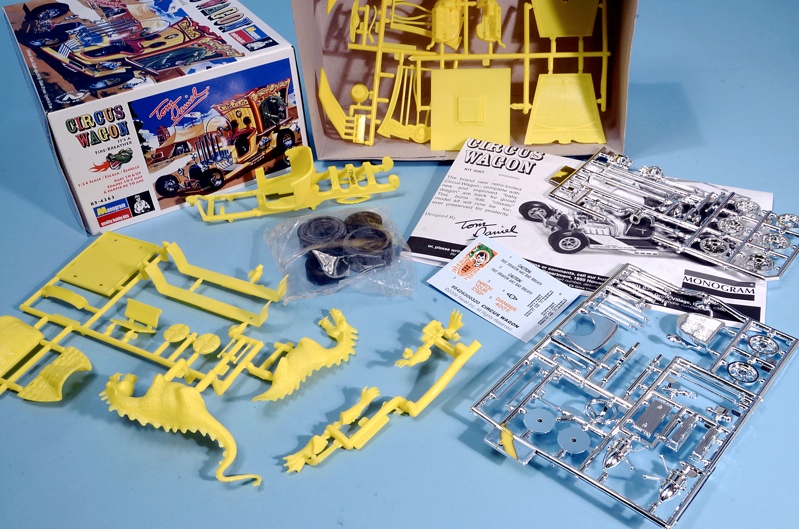
The Tom Daniel ‘Dragon Wagon’ from 1970 has been updated with a mould re-tool, a new name, and a new box. For 1:24 scale custom fans, it’s one of many similar kits on the launch pad from Revell-Monogram, even if this one is now called a ‘Circus Wagon.’


According to the kit’s designer, famed US auto customizer, Tom Daniel, “I was on a roll with these hot-rodded work trucks when I did the Dragon Wagon. Of course, the ‘Dragon’ was a metaphor for ‘Draggin’ or drag racing. So I put a baby dragon in a circus vehicle. I dressed it up with calliope injection stacks, a monkey for the hood ornament and tiger tail for the shifter. Overall it turned out pretty neat!”


Tom’s dream
There’s more from Tom in the kit instructions, “It all came… in a dream… being pursued by this fire-breathing dragon…” which he promptly captured (as you do in dreams) and built the wagon so he could, “…take it on circus tours, as the 10th Wonder of the World.” So the vehicle has a circus theme, with a caged dragon at the rear - though note that the bars are already bent.


Mods for the new kit
Because the mould has been retooled, a few modifications have been made along the way. Most noticeable, though it doesn’t change the overall look, is that the dragon now has four separate legs and two body halves, whereas the original made do with just two components for the whole thing.


Parts list
The kit has 76 parts, mostly moulded in yellow, with two chrome-plated runners for the bright shiny bits, and a clear, circular windshield. There are also four vinyl tyres - two front performance designs and a pair of wide rear slicks. When assembled, the 1:24 scale machine measures 160mm (6.3in) long.


Summation
An interesting kit from 1970, and it’s such good news that Tom Daniel’s designs are seeing the light of day again. I do wonder though, why he called it the ‘10th Wonder of the World.’ Given that there are usually only seven wonders, what happened to numbers eight and nine?


Visit Tom Daniel here.

Various Monogram custom kits here.

INCOMING: SECRET BLADE RUNNER FLYING ‘FUTURE CAR’ FROM FUJIMI


SMN REPORT:
Did you enjoy the classic sci-fi movie, Blade Runner? Did you laugh at the Back to the Future (BttF) time-travel trilogy? If so, we bet you didn’t know that Blade Runner’s Spinner cop car also appeared in the second BttF movie. And now here it is again, coming shortly as a 1:24 scale kit, from Fujimi of Japan.


The latest Fujimi 1:24 scale sci-fi kit, simply titled ‘Future Car’ features a vehicle that’s said to be briefly seen in Back to the Future II - so very brief, in fact, that the SMN Crew fast-forwarded the DVD last night without spotting it. However, we live in hope and will sleuth some more tonight!


Sleeker Spinner
The new injection-moulded car is essentially a standard Fujimi Spinner kit, less police accessories such as the roof lights, though they are included in the box. As you can see from the box-top art (header pic), the overall look of the Future Car is somewhat sleeker than the police Spinner, so it’s none the worse for being minus some items.

Parked Spinner
We’re told that the BttF prop was an actual Spinner, which had been parked in the studio back lot. Kudos to the movie-makers, and another cute car (a befinned Cadillac also cruised around in a scene or two) for sci-fi nerds like us to search for.


The original Spinner kit
This injection-plastic kit has plenty of tidy detail, and - suitably - can be posed in either ground-car or flying-car modes. Components are mostly supplied in white and transparent, though the police lights are red and blue, with two more in clear, ready for painting orange. The Italian specialist decal outfit Cartograf has supplied a comprehensive decal sheet, and there are also three photo-etch Spinner logos, for decorative purposes.


Time-saving Fujimi paint job
Fujimi also makes a pre-painted Spinner, which has the main components supplied in a finished state. This could be a useful desktop quickie for you, though as usual with pre-finished models, the keen enthusiast will want to make it look better with some extra work, especially with panel detail, and some overall light weathering to give it a ‘working machine’ sense of reality.


Deckard Sedan  
Fujimi’s Blade Runner set is finished off (only for the moment, we hope) by the 1:24 scale Deckard Sedan kit. This is the ground-car driven in the movie by the robo-hunter Rick Deckard, played by Harrison Ford.


Summation
The Future Car is an unusual kit from Fujimi, and we’re looking forward to its May arrival immensely. Let’s hope Fujimi carries on with the 1:24 scale Blade Runner series, as there are plenty more vehicles lurking in the rain-washed streets of near-future Los Angeles.


More Spinners at SMN here.

See the Fujimi future cars in 1:24 scale here at Hobby Link Japan.

Fujimi stuff here, including Blade Runner kits.


Blade Runner movie poster (above) and (below) stills with Spinners. The movie was released back in 1982, the plot setting the story in 2019. 


Model pictures courtesy Fujimi and Hobby Link Japan.

Tuesday, April 2, 2013

INCOMING: SOVIET-ERA MOON LANDER FROM THE GLORY DAYS OF THE SPACE RACE


SMN REPORT:
Coming in to land next month is this intriguing LK Moonship kit from those masters of rare and fascinating sci-fi and space models, Fantastic Plastic.


The Soviet LK - letters standing for the Russian, ‘Lunniy Korabl’ or Lunar Ship - was a counterpart to the US Lunar Module (LM). It was smaller than the LM though, and a simpler design in general. There was no separate docking hatch for example. Instead, the pilot would have climbed inside for the Moon landing via a space walk. Also, there was no separate ascent engine, the same one being used for both landing and takeoff from the Moon’s surface. Like the LM, the LK (left below) design used its landing-gear assembly as a launch platform.


1:48 scale model
The Fantastic Plastic model looks to be an interesting one, though we don’t yet have details as to how many components will be in the box. It will be primarily a resin kit, to 1:48 scale. The real thing was some 5.2m (17.06ft) high, with a span across the landing legs of 5.4m (17.7ft), giving 1:48 scale equivalent sizes of some 108mm (4.25in) and 112mm (4.4in) respectively.


Display base
We’re pleased to add that Fantastic Plastic will be including a lunar landscape display base and a cosmonaut figure. At just under 40mm (1.5in) high, the cosmonaut could turn out to be a miniature work of art, if you take some time and trouble with the air- and paintbrushes.

Double landing?
Diorama what-if concepts spring to mind - how about a US-USSR double-landing, with astronauts and cosmonauts raising a single United Nations flag? Or (more likely for the time) competing to see who could unfurl the biggest pennant - stars and stripes or hammer and sickle?  

No chance for Moon missions
It’s a huge shame though, that any such diorama would be strictly in the land of maybe, for the real LK never got the chance to make a Moon landing. The craft went far beyond mere concept and specification, being tested successfully in Earth orbit, but the failure of the big N-1 moon rocket and the success of the Apollo landings resulted in the whole Soviet lunar landing programme being cancelled.

Summation
Looks a great little kit, that'll be a fascinating must-have for all space buffs. It’s due from Fantastic Plastic in May 2013, and we’ll be watching closely for this one.

Note: In Cyrillic, the LK’s full name reads: Лунный Корабль. Nifty, huh?

Interesting mini-vid at Russian Space Web here.

More info at Fantastic Plastic here.


Pictures courtesy Fantastic Plastic and Eberhard Marx, 2008.