Passion for Precision

Showing posts with label SSP. Show all posts

Thursday, December 8, 2011

2012 PRODUCTS REVEALED - INCOMING KITS FROM REVELL-MONOGRAM


From Mat Irvine:
Here’s a look at Revell-Monogram kits for release in 2012. I’ve previously  mentioned the recreated Renwal Blueprint series, with the futuristic Teracruzer and Mace missile, but there’s much more coming down the line.


Car kits
First up, the lime-green 1932 Ford 'Rat Roaster' (above) shown at October’s International iHobby Expo in Chicago was a taste of things to come, as the car will soon be released as a brand-new 1:25 scale kit. In fact, there’s a feast of US wheels coming our way, as the Rat Roaster will be joined by a 1950 Oldsmobile Coupe, representative of an automobile marque that has largely slipped through the running boards until now. This fully-detailed kit, seen as a test shot at iHobby, will have various build options, including the choice of finishing as a plain-Jane stock version, or hopped up as a mild custom. Both the Ford and Oldsmobile should be available early 2012.


Metal to plastic Corvette
The 1962 Corvette will also be available around that time. It isn’t totally new, having been issued before, but it previously had a metal body, and was made as a ‘Route 66’ machine. The new kit will be all-plastic, but various updates should freshen it up. And there’s more, even if at first glance we seem to have had a 1957 Ford before, but not this version, the Ford Custom. This may seem very similar to other 1957 models, but is actually shorter, and with different details.


SSP two-packs
Amongst the SSP (Selected Subjects Program) releases will be two duo kits (above), the 1:48 scale Mercury and Gemini spacecraft, and a pair of deeply cool-looking 1:25 scale Tony Nancy dragsters. 


Underwater Demolition Team
For fans of things that float comes a reissue of the 1:32 scale UDT (Underwater Demolition Team) boat, complete with frogmen. This will be released as a Revell kit, as it was last time around in 1992, though it had started life as a Monogram kit, back in the early 1960s. Even then, it was very detailed and comprehensive, features which were typical of Monogram kits of the time. It was titled: ‘US Navy Frogmen’, and came complete with a five-man underwater demolition team, a rubber liferaft, and the UDT vessel. Now you still get the liferaft and figures - they have full scuba gear - but the UDT boat takes pride of place. As the kit is made to a standard scale, even if you don’t build it ‘as intended’, it could still be very useful as a supply source for a range of bits and pieces - support for other models you might have planned.

More info here.

Renwal mentions in SMN here.


Revell-Monogram at the 2011 iHobby Expo. Note products from Revell-Germany are displayed at right.


Bill Lastovich of Revell-Monogram adjusts a display.

Tuesday, July 13, 2010

MISSILE KITS FEATURING THE COLD WAR CORPORAL MISSILE


Mat Irvine reports
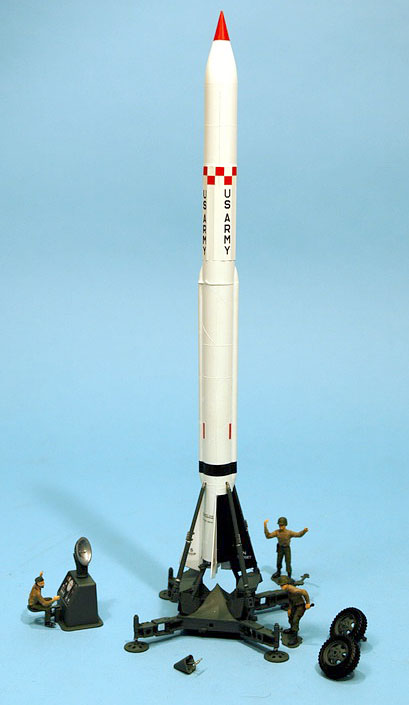
From around 1955, one of the mainstays of the US Army’s military might in Europe was the surface-to-surface Corporal ballistic missile, the first such to carry a nuclear warhead. The 139 km (86 mile) range Corporal looked sleek and functional, but in reality was very unreliable and took a large number of personnel to ready it for launch. But the Corporal did prove an ideal subject for the early Revell company’s growing range of space and missile kits, and it now stars as another of Revell-Germany’s Classic Kit range reissues.

Uniquely, Revell issued the kit in two forms, one of which consisted of the missile and launcher, with three crew and a stand-alone tracking station; it’s this kit that Revell-Germany has reissued, using the original box-art as a centrepiece, with the ‘Classic Kits’ medallion added.

These types of kit had to have ‘working parts’, so the launcher’s support arms were designed to be foldable, the transporting road wheels can be unsnapped, and support pads placed. So, position the missile for launching (or glue if you want to avoid the danger of it falling over!), add the unrealistic number of crew (three is something of an underestimate - Corporals needed about 250!), and you have a classic icon of the Cold War.

But as noted, the Corporal was issued in two forms. The other kit came with the still-futuristic looking Transporter-Erector, as well as the missile and launch pad, and this kit has been reissued separately by Revell-Monogram.

This is a pure reissue, as R-M has not put it in the SSP range, (which still exists, though much reduced), with a built model on the box. This is only the third outing for this kit - the original from 1959, the History Makers Series II in 1983, and now this one in 2010. The Transporter-Erector has even more ‘working features’- from the clamps that hold the missile in place, to the gearing that moves it through 90 degrees for placement on the launch pad. The pad itself can be hitched up behind the main vehicle.

As an intriguing aside, both kits are to the original scale intended for military vehicles, 1:40, as used by Revell at that time, and others such as Adams. The only real alternative then was 1:32, which was used by Renwal. The now common 1:35 scale for AFVs had yet to appear - though when it did, it wasn’t from a Japanese manufacture, as I suspect is usually assumed. In fact, it was almost certainly first used by Monogram. However, this now almost universal use of 1:35 led to an incorrect scale being put on the Revell-Germany box, which states 1:35, not 1:40.

The pictures show, top to bottom:
1  Three Transporter-Erector kits, with the original (and best-looking) box at right.
2  A selection of parts from the reissues, laid out side by side. Note the different shades used for components.
3  Revell-Germany’s Corporal, ready for flight.
4  Revell-Monogram’s Transporter-Erector builds into an impressive piece of hardware.
5  The R-M Transporter-Erector with Corporal awaiting a launch decision.


Saturday, July 3, 2010

CHANCE VOUGHT CUTLASS - EARLY US NAVY JET REVIVED BY REVELL AS A CLASSIC KIT


Mat Irvine reports
Revell Germany has recently released another batch of Classic Kits, and this includes one of the oldest originals to be reissued to date, the F7U-3 Cutlass, dating back to 1953. This really does make it an ‘old style’ model kit, from the prominent raised rivets and etched-in decal placements, to the odd 1:60 scale, as it comes from a time when many kits were made to ‘fit the box’ size, not to a standard scale. 

Nicely sculpted pilot figure
Moulding on this Cutlass is on the heavy side, which was fairly usual for the period and has little of the fine detail you would expect from a modern kit, but the pilot figure - although moulded to his seat - is actually not too bad. Four early-model Sparrow missiles are provided as armament, though these are fairly basic in shape and detail.

Revell Selected Subjects Program
The idea of these Classic Kits originally came from the American side of the ‘Revell’ name, Revell-Monogram (technically now a separate company), who introduced the idea of the Selected Subjects Program (SSP) in the early 1990s. Here old kits would be reissued ‘exactly’ as they would have been originally, which meant the same box art, decal layout, and reproductions of the original plans, with only odd but necessary changes, such as a bar code. Revell Germany’s Classics Kits follow the same reasoning, except that the boxes aren’t absolutely identical. They certainly use the original box-art - in fact, I have lent the company several original boxes, so they can be scanned for reissue purposes. But this Classic Kits box features a reduced-size Cutlass painting, and a ‘medallion’ logo is prominent on the right-hand side.

New decal set included
However, good news is that, so far as the decals and painting instructions are concerned, Revell-Germany has treated the Cutlass exactly like a modern kit. With the original release, you would have probably got the Stars and Bars, ‘NAVY’ lettering and a couple of serial numbers - perhaps 10 decals in all. Now though, the decal count has shot up to no less than 66! The painting instructions are also comprehensive, giving full details for two aircraft, one for the Air Development Squadron, Point Mugu, California, in 1953, the other for ‘Project Cutlass’ at the Naval Air Station Miramar, Florida, 1954.  These are things you wouldn’t have got in those ‘old days’.

Keep watching for more of these Classic Kits - they are a real eye-opener on the construction kit industry’s progress over the years.

The YouTube video, courtesy ‘jaglavaksoldier’, shows some excellent views of the Cutlass, one of the most interesting-looking US Navy jets from this period.

The pictures show, top to bottom:
1  The box has a main image painted originally by Richard Kishady, who did a number of others for early Revell releases.
2  In case there is any doubt on the original release date, it’s stamped inside the fuselage nose.
3  It looks odd these days, but it was common practise in early US commercial plastic kit to etch in marking outlines, so a young model maker knew exactly where to place decals.
4  The Sparrow missiles are a bit basic, but the pilot figure is nicely sculpted.
5  New for this release is the highly detailed decal sheet and instructions.

You can find the Chance Vought F7U-3 Cutlass here.

*** An update on this Revell Cutlass story will be posted soon - keep an eye open for it... 

Sunday, January 17, 2010

REVELL AEROBEE-HI - A CLASSIC KIT FROM SPACEFLIGHT’S EARLY YEARS


Mat Irvine reports
Rocketry is about more than space launchers or missiles - there's also an important branch that has played an important, though mostly unsung role - sounding rockets.

Named because they ‘sound out’ what’s going on ‘up there’, sounding rockets have launched small payloads to the edge of space, carried instruments to great heights, and been important in rocket motor development. The two most important such rockets have been the British Skylark series (last flight 2005) and the American Aerobee.

From first flights way back in 1947, the Aerobee was developed into the Aerobee-Hi (first flight 1955), the X-8 ‘X-Plane’, and the 150, 170, 300 and 350 series. They varied in performance, including altitude, from 130-450 km (81-280 miles) but all were suborbital. 1037 Aerobees flew in total, the final one being a 150-series launched by NASA on January 17, 1985, making today the 25th anniversary of that last flight.

Scale models of sounding rockets have been few and far between, though rocketeer hobbyists do fly replica Aerobees. Some of these carry instruments and are so large that they are actually classed as small sounding rockets.

Plastic kits are even fewer, but Revell did make a kit of the Aerobee-Hi, the type that would have been launched from White Sands and Wallops Island in the late 1950s and early 1960s. It was in the same Revell S-Series range that featured various rockets and missiles, though the Aerobee-Hi and X-17 were the only ones that were first and foremost ‘experimental' rockets.

The kit is typical of Revell from that period - as well as the rocket, the box also contained a transporter-launcher and three crew, one of whom was sculpted wearing a fireproof suit. The kit looks good, with fair attention to detail, and the erectable transporter-launcher really adds to the appeal. A pity though, that Revell never included a pickup truck (a Ford F-series would have fitted the bill) to finish things off.

The Aerobee-Hi was not reissued until the start of Revell's Selected Subjects Program (SSP), so was on the ‘wanted’ list of many modellers for a long time. But in Summer 1996, the SSP Phase 15 included the Aerobee-Hi, allowing many modellers to actually build the kit, not just stare at the bits in a box. Will it be reissued again? Here’s hoping!

The pictures show, top to bottom:
1 Compare the boxes. Some SSPs have been in differently-sized boxes to the original, but the Aerobee-Hi matched exactly, so much so that at first glance it’s difficult to tell them apart. Here the original is on top, the SSP box looking slightly ‘electronic’ and ‘bright’, as it was scanned from an original, but is still pretty good.
2 The side panel gives a few things away. The SSP issue does not mention Revell’s Type “S” Cement’ (it hadn’t been made for years) and you can just make out newer copyright details and address.
3, 4 Two views of the assembled kit, in transport position and raised for launch.

The Aerobee-Hi is not presently available from new, but you can see another Revell reissue, the 1:40 scale Nike-Hercules missile here.