Passion for Precision

Showing posts with label Renwal. Show all posts

Thursday, December 8, 2011

2012 PRODUCTS REVEALED - INCOMING KITS FROM REVELL-MONOGRAM


From Mat Irvine:
Here’s a look at Revell-Monogram kits for release in 2012. I’ve previously  mentioned the recreated Renwal Blueprint series, with the futuristic Teracruzer and Mace missile, but there’s much more coming down the line.


Car kits
First up, the lime-green 1932 Ford 'Rat Roaster' (above) shown at October’s International iHobby Expo in Chicago was a taste of things to come, as the car will soon be released as a brand-new 1:25 scale kit. In fact, there’s a feast of US wheels coming our way, as the Rat Roaster will be joined by a 1950 Oldsmobile Coupe, representative of an automobile marque that has largely slipped through the running boards until now. This fully-detailed kit, seen as a test shot at iHobby, will have various build options, including the choice of finishing as a plain-Jane stock version, or hopped up as a mild custom. Both the Ford and Oldsmobile should be available early 2012.


Metal to plastic Corvette
The 1962 Corvette will also be available around that time. It isn’t totally new, having been issued before, but it previously had a metal body, and was made as a ‘Route 66’ machine. The new kit will be all-plastic, but various updates should freshen it up. And there’s more, even if at first glance we seem to have had a 1957 Ford before, but not this version, the Ford Custom. This may seem very similar to other 1957 models, but is actually shorter, and with different details.


SSP two-packs
Amongst the SSP (Selected Subjects Program) releases will be two duo kits (above), the 1:48 scale Mercury and Gemini spacecraft, and a pair of deeply cool-looking 1:25 scale Tony Nancy dragsters. 


Underwater Demolition Team
For fans of things that float comes a reissue of the 1:32 scale UDT (Underwater Demolition Team) boat, complete with frogmen. This will be released as a Revell kit, as it was last time around in 1992, though it had started life as a Monogram kit, back in the early 1960s. Even then, it was very detailed and comprehensive, features which were typical of Monogram kits of the time. It was titled: ‘US Navy Frogmen’, and came complete with a five-man underwater demolition team, a rubber liferaft, and the UDT vessel. Now you still get the liferaft and figures - they have full scuba gear - but the UDT boat takes pride of place. As the kit is made to a standard scale, even if you don’t build it ‘as intended’, it could still be very useful as a supply source for a range of bits and pieces - support for other models you might have planned.

More info here.

Renwal mentions in SMN here.


Revell-Monogram at the 2011 iHobby Expo. Note products from Revell-Germany are displayed at right.


Bill Lastovich of Revell-Monogram adjusts a display.

Tuesday, November 22, 2011

RENWAL TERACRUZER WITH MACE MISSILE - UPDATE


SMN report:
Reference last week’s mention of the upcoming Revell-Renwal Teracruzer and Mace reissue, Mat Irvine has kindly supplied these pictures of an assembled model. We’ve also shown the original box, so you can see the minor differences between the then-and-now kits. 


More than just a static model
You can also see that the kit has a classic hallmark of the era - working parts, indicated by the words: “fully operating model” on the box. The Mace can be displayed in a horizontal stored position, or raised into launch-ramp firing mode. In that respect, it’s quite similar to many of the better diecasts of the time, such as the Corgi Bloodhound anti-aircraft missile.


Renwal design features
The Mace shares useful kit-design features with the M65 Atomic Cannon, described by Renwal as “Positive Assembly” and “No Show” cementing. Designed in the first place as helpful aids to younger modelmakers, these are factors that could still appeal to anyone with a shaky hand.

Look out there!
Incidentally, those big, squashy Rolligon tyres on the Teracruzer resulted in an amazingly low ground pressure. At least one launch crew member was recorded as being accidentally run over, with no serious after-effects. The same soldier was able to light up a cigarette from his non-quite flattened pack afterwards - though rather shakily we suspect!

More on kits of the Mace and its predecessor Matador missile, described by the US Air Force as a: “ground-to-ground tactical pilotless bomber” here.

Mat’s M65 article here.

Mat’s Mace article here and his Atomic Cannon piece here.

Corgi Bloodhound spotted on ebay here.

Book about Renwal here.


Wednesday, November 16, 2011

RENWAL’S LARGEST MILITARY KIT - THE US ARMY M65 ATOMIC CANNON


From Mat Irvine:
Revell has owned most of the old Renwal company’s moulds for decades - actually, since 1976 - and has reissued many of those kits. So far, these have been released in Revell boxes, but now, thanks to Product Manager Ed Sexton, the original distinctive Renwal box-art has been reintroduced, including the Renwal name.

Blueprinter series
One thing Ed liked about the original art is that Renwal issued military kits in its ‘Blueprinter’ series, as the company maintained proudly that such models were designed: “from original blueprints”. To this end, the boxes featured a distinctive blue-chequer design - OK maybe not a real blueprint, but it looked good! 


Bill Lastovich (left) and Ed Sexton of Revell-Monogram.
Mobile artillery
In 2010, Revell reissued the 138-part Renwal 1:32 scale Big Shot self-propelled howitzer, complete with six-man combat crew and working features. Now it’s the turn of an even bigger kit, the Renwal M65 Atomic Cannon. The original mobile artillery piece was enormous at 25.6 m (84 ft) total length, and the Renwal 1:32 scale kit is equally impressive, at 851 mm (33.5 in) long. Seven crew are included in the box - a US Army gun crew could deploy the massive weapon in just seven minutes.  The moulding colour is light grey, (the original was army-issue olive drab), and the parts count is still over 300. You get the cannon, plus the two tractor units, one at each end. 


More than 300 components fill the Atomic Cannon's sturdy box.

No cement visible
Renwal made great play on the fact that cement join lines were hidden from view - it was termed ‘No Show’ - and as was typical for kits of that period, there many working parts were designed into the kit. The gun itself elevates, recoils, and when placed ‘on the ground’, can be rotated. The tractors come with rotating wheels, and the ability to attach and detach the cannon from cradles. However, these cradles should not stay with the cannon. This was an error made in the early-1980s Revell ‘History Makers’ reissue, where the box photo showed this incorrect scenario. 


The 1983 History Makers issue shows incorrectly-placed cradles, still attached to the gun.


Big Shot howitzer, reissued in 2010.

Box talk
Talking of boxes, unlike that of the Big Shot howitzer, this one isn’t identical to the original. Ed Sexton admits he thought the original lettering was a bit understated, so it is now bigger and more distinctive, being set centre-stage on a box that is a different ratio to the original.

Not quite the biggest kit
Big as it is, the Renwal Atomic Cannon is not the largest kit ever made - it isn’t even Renwal’s largest kit  (see link below) but it remained supreme in scale military vehicles, really until the 1:35 scale Dora rail gun came along. All in all though, the Revell-Renwal Atomic Cannon is a terrific piece of scale model technology, and should be in every AFV fans collection. 


Atomic Cannon on display at the Aberdeen Proving Grounds.


The real thing
The last of the 20-plus M65 Atomic Cannon constructed left military service in 1963, though one was used at the Nevada Test Site on May 25, 1953, the only time the M65 actually fired a nuclear shell, a 15-kiloton device that was lobbed 11 km (7 miles) in a test-firing code-named 'Grable'.


Atomic Cannon today
Eight M65s still survive, displayed at various US museums, though only the one pictured, at the Aberdeen Proving Grounds, Maryland, still has its tractors attached. Note that this site is currently under review, and at some point the exhibits may be moved to a new museum being created at Fort Lee, Virginia.

SMN ‘biggest kit’ article here.

Thanks for information to Ed Sexton and Bill Lastovich at Revell-Monogram LLC.   

Tuesday, November 15, 2011

COLD WAR WARRIOR RETURNS - MACE MISSILE FROM RENWAL


SMN report:
Mat Irvine spotted the next Revell reissue of a classic Renwal military kit when he was at the iHobby Expo  recently. It will be the futuristic Teracruzer and Mace missile set, and as you will read in Mat’s article later today, there’s been a sea-change at Revell where packaging is concerned.


Original boxes revisited
Instead of the photo-style ‘History Makers’ packaging previously used, the Mace and other kits are now being treated to a revamp of the original Renwal boxes - and that’s excellent news, for they really were designs of their time, and deserve to be seen again.


Mace - an early form of cruise missile
Inside the brightly coloured box of the 1:32 scale Teracruzer and Mace kit, you get 278 components, including a combat crew of five figures, three of whom are shown below.


Cold War warrior
The Mace was a nuclear-tipped winged missile, launched straight off its transporter-launcher with the aid of a rocket booster, which dropped away after a short but powerful burn, after which a turbojet engine cut in for the cruise portion of the flight. Typical speed was around 1050 km/h (650 mph), and maximum target range some 2250 km (1400 miles). Renwal correctly prefixed the Mace with the tactical missile designation TM-76 (see cover art) though this was changed in 1963 to MGM-13, denoting the  mobile launch version - the CGM-13 could launch straight from a storage container.


Big, soft tyres
The MM-1 Teracruzer was a balloon-tyred transporter, those massive rubber do-nuts (named Rolligons) allowing for off-road travel, even across ploughed fields - just the terrain found in Germany where the weapon system was deployed. Having said that, experienced opinion from a serving officer of the time reckoned that a nine-man crew was needed, and that they were based mostly on hard-standings, with shelters: “...to keep the weather, especially Germany’s freezing fogs and snow, off the ‘birds’”.

Farewell Mace
The last Mace missile was decommissioned in 1969, but Teracruzers haven’t disapppeared entirely. They can be found here and there in civilian jobs - apparently one still works hard in an Alaskan gold mining operation!   

Welcome return
It’s a real pleasure to see these old kits coming back in their original packaging - just wait until the Mace hits the stores, and don’t forget to read about the Renwal Atomic Cannon in Mat’s upcoming article...

Tuesday, July 13, 2010

MISSILE KITS FEATURING THE COLD WAR CORPORAL MISSILE


Mat Irvine reports
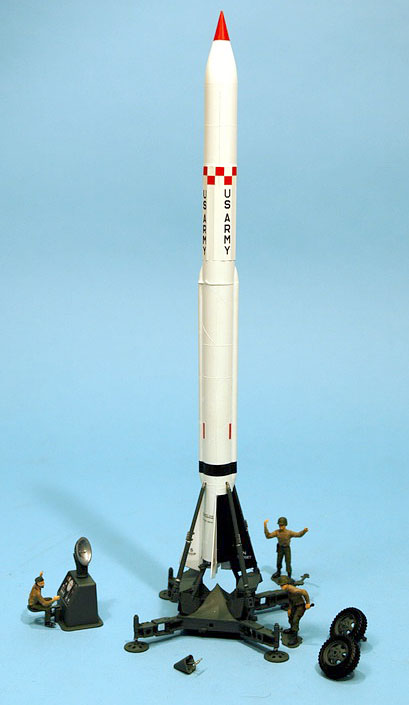
From around 1955, one of the mainstays of the US Army’s military might in Europe was the surface-to-surface Corporal ballistic missile, the first such to carry a nuclear warhead. The 139 km (86 mile) range Corporal looked sleek and functional, but in reality was very unreliable and took a large number of personnel to ready it for launch. But the Corporal did prove an ideal subject for the early Revell company’s growing range of space and missile kits, and it now stars as another of Revell-Germany’s Classic Kit range reissues.

Uniquely, Revell issued the kit in two forms, one of which consisted of the missile and launcher, with three crew and a stand-alone tracking station; it’s this kit that Revell-Germany has reissued, using the original box-art as a centrepiece, with the ‘Classic Kits’ medallion added.

These types of kit had to have ‘working parts’, so the launcher’s support arms were designed to be foldable, the transporting road wheels can be unsnapped, and support pads placed. So, position the missile for launching (or glue if you want to avoid the danger of it falling over!), add the unrealistic number of crew (three is something of an underestimate - Corporals needed about 250!), and you have a classic icon of the Cold War.

But as noted, the Corporal was issued in two forms. The other kit came with the still-futuristic looking Transporter-Erector, as well as the missile and launch pad, and this kit has been reissued separately by Revell-Monogram.

This is a pure reissue, as R-M has not put it in the SSP range, (which still exists, though much reduced), with a built model on the box. This is only the third outing for this kit - the original from 1959, the History Makers Series II in 1983, and now this one in 2010. The Transporter-Erector has even more ‘working features’- from the clamps that hold the missile in place, to the gearing that moves it through 90 degrees for placement on the launch pad. The pad itself can be hitched up behind the main vehicle.

As an intriguing aside, both kits are to the original scale intended for military vehicles, 1:40, as used by Revell at that time, and others such as Adams. The only real alternative then was 1:32, which was used by Renwal. The now common 1:35 scale for AFVs had yet to appear - though when it did, it wasn’t from a Japanese manufacture, as I suspect is usually assumed. In fact, it was almost certainly first used by Monogram. However, this now almost universal use of 1:35 led to an incorrect scale being put on the Revell-Germany box, which states 1:35, not 1:40.

The pictures show, top to bottom:
1  Three Transporter-Erector kits, with the original (and best-looking) box at right.
2  A selection of parts from the reissues, laid out side by side. Note the different shades used for components.
3  Revell-Germany’s Corporal, ready for flight.
4  Revell-Monogram’s Transporter-Erector builds into an impressive piece of hardware.
5  The R-M Transporter-Erector with Corporal awaiting a launch decision.


Wednesday, December 9, 2009

SHADES OF RENWAL’S VISIBLE MAN - CLEAR PARTS LET YOU LOOK INTO THE SOUL OF YOUR MODEL


Decades ago, the US Renwal company came up with the bright idea of making a transparent model that revealed the insides of its subject, a 3D version of the traditional cutaway book illustration. The Renwal Visible Man was a big success, and was soon joined by the Visible Woman (though without private parts to allow her to give birth), the Visible Engine, and others that included even a Visible Dog.

Apart from these early stalwarts, transparency has been largely ignored by manufacturers over the years, but the magic of ‘seeing inside’ is still there, and the latest convert to the idea is Trumpeter. Its big 1:32 scale Fairey Swordfish is absolutely a gem in this department, with a transparent port fuselage section that allows you to gaze inside the ‘stringbag’s portly form. You can mask off parts for painting, to reveal more or less of the interior, as you wish.

The recently introduced MkII Swordfish joins the already available MkI, and is packed with detail, has a wingspan of some 433 mm (17 in) and has a box stuffed with no less than 373 components. Wire bracing on biplanes has become a near-standard fixture on ready-built models such as those of Corgi, but here on Trumpeter’s Swordfish, you get to do it yourself with a supplied wire bracing set. Never the easiest of jobs, at least the big 1:32 scale helps, though this reviewer will pass on the job to a more nimble-fingered craftsman.

All in all, a fine addition to the ranks of see-inside models, and an excellent kit of a World War II classic aircraft.

Visit Trumpeter here.

You can buy the Trumpeter 1:32 scale Swordfish MkI here.

Friday, May 1, 2009

MAT’S US DIARY: NIKE PARK


One of the most exciting series of models in the 1960s were those from Renwal. These were large-scale kits of exotic US ships, subs and tanks, including the then largest model kit made, the almost three-foot long Atomic Cannon.

Some of Renwal’s kits were re-boxed for the UK market by Frog, under the ‘Frog-Deluxe’ name, with virtually everything being the same except for the change of logo. Amongst the military kits was the Nike Ajax, one of the first anti-aircraft missiles to be built, and named after the Greek goddess of victory.

By today’s standards the missile was extremely primitive, but then it was the ultimate in technology and many American cities were ringed with Nike Ajax missile batteries. Chicago was no exception, and a number of outlying areas had Nike batteries. But technologies change and the large fixed sites were displaced with smaller, more mobile options. The sites then became abandoned and overgrown - eventually, many would find an industrial park or a shopping mall built over the top.

But some remnants are still around, and there is one near where I’m staying, in the town of Addison. The original site is now a municipal park, called, um, appropriately Nike Park, and this one at least has of its two original features still standing - more or less - the radar platform and the original control building. The former is really ‘just there’ now, not fulfilling any function at all, except probably as a nesting place for birds, but the latter has been updated and likely contains power control systems for modern needs, such as lighting for the baseball field.

Nothing of the original Nike missile batteries themselves survives, but just get a few of those original kits (and they were reissued by Revell in its ‘History Makers’ series) and you can recreate what was - for a short time at least - the ultimate sophistication of Cold War anti-missile defence!

Mat Irvine

The pictures show the Renwal Nike Ajax kit box (top). It included details of how to join several kits together, so you could build your own missile battery, perhaps to protect the front room...

Mat poses by a Nike Park sign (middle), now in a somewhat flattened state.

The radar platform, with steel panelling round the spiral stairs, to stop anyone who wants a higher view.

Monday, April 27, 2009

MAT’S US DIARY: KANE COUNTY TOY FAIR


Kane County sits west of the Chicago metropolis and hosts the twice-a-year Toy Fair at its fairground, something (a fairground, that is) that no self-respecting American town can do without. I was last there in October 2008, but new buildings have sprung up since, meaning that a lot of what used to be held in, frankly, the animal sheds, could be moved inside. But two such sheds remain in use. They are otherwise reserved for ‘Cattle’ and ‘Swine’ (‘Rabbits’ was not in operation this year!). Apparently Kane County’s Toy Fair used to be a lot larger than it is now – but it’s still pretty big.

The Toy Fair does more or less what it says on the tin. It’s a fair for the selling of toys - plus models, dolls and other collectibles - and stall after stall has a wide variety of bits and pieces that are likely to be junk to most people, but maybe a treasure to others. We all set off - me and my other half Georgy, Dean Milano and wife Gay, and were joined by Gay’s daughter Kim and her elder son, Jack, all of seven years old.

It didn’t look exactly promising as the forecast was for a downpour, and with rain threatening when we arrived, by the time we got under cover, it was coming down like stair-rods – but that meant all the more time for browsing!

You never know what you might find at these sorts of fairs – plus not being ‘from around these parts’ they are mostly going to be different from the sort of finds at a British equivalent. So you wander from stall to stall, peering at stuff that may be hidden under other stuff, or tucked away under the table. Then you bargain. Using the Middle Eastern principle that the price marked is only a rough indicator and should never be taken at face value, the first question should always be, “What’s your best offer on this?”, followed by the sort of look that indicates that it had better be a ‘good offer’. Actually, most are just that. Invariably when I’d seen something at $25, and having asked the question and expecting $20, and $18 came back (as it did on one occasion)... well, it would be churlish to turn it down! So by the end of the day - and by now with the Sun out - a few more items had been added to the Mat Irvine Collection.

The pics show (top) a kit I’d never seen before, at least in this box – the original Renwal kit of the Mercedes 300 Gullwing in 1:12 scale. Gay found me an astronaut (middle), though I didn’t take her up on the offer! Georgy (bottom) gazes at just one stall’s wares.