Passion for Precision

Showing posts with label Apollo 11. Show all posts

Wednesday, April 10, 2013

YEAR 1970: APOLLO 13 EXPLOSION. YEAR 2013: APOLLO 13 DIECAST FROM BANDAI


Bandai from Japan has pulled out all the stops with this 1:144 scale ready-built model, featuring the various components of the nearly-disastrous Apollo 13 space mission of 1970.

The Bandai 1:144 scale miniature is little short of astonishing. Every last detail seems to have been incorporated, from the damaged Service Module (SM) to a mini-diorama that features a floating Command Module (CM), a pair of divers with flotation collar, and a Sikorsky S-61 helicopter.


Stage treatment
The Saturn V is nicely detailed and coloured. We particularly like the treatment of the tanks within the main stage cylinders.


Stacked for launch
The whole Apollo assemblage can be displayed stacked and ready for flight, or you can separate the various parts into sections. For the latter, Bandai provides a set of mounts so the various Saturn V stages have no chance to roll away. The vertical display option has a base with transparent support arms, looking somewhat like the system used for real-life Russian Soyuz launchers. In launch configuration, the 1:144 scale Saturn V stands some 768mm (30.25in) high, plus display plinth.


Care and attention
We’ll let the pictures do most of the talking from here on, as you need to look and admire the care and attention that Bandai’s product engineers have put into this Apollo 13 model.


About Apollo 13
Apollo 13 was the seventh US manned Moon mission, and the third intended to land on the surface. The huge Saturn V launcher blasted off safely on April 11, 1970, at 13:13 CST from the Kennedy Space Center, Florida, but two days later an oxygen tank in the Service Module exploded, crippling the spacecraft.


Deadly danger
The lunar landing part of the Apollo 13 mission was aborted, the issue becoming one of getting the crew back to Earth safely. Despite problems caused by limited power, loss of cabin heat, shortage of drinking water, and the need to carry out makeshift repairs to the carbon dioxide removal system, the Command Module and crew splashed down safely in the Atlantic Ocean five days later, on April 17.


Summation
An excellent ready-built that is the last word on Apollo 13 at 1:144 scale. Right then, Bandai - what are the chances for a giant-sized 1:72 version?! The Bandai Apollo 13 to 1:144 scale is available from July 2013.


You can pre-order this and also Apollo 11 to the same scale from suppliers such as Hobby Link Japan.

Interesting space stuff from Bandai and others here.


Wednesday, October 19, 2011

UNBOXING THE DRAGON 1:72 SCALE APOLLO 11 SPACECRAFT


Mat Irvine looks inside:
Model companies can spring surprises, and such was the case when Hong Kong-based Dragon recently announced brand new 1:72 scale kits in of the Apollo craft. Anyone familiar, even in passing, with kits of space subjects will be bound to know of the Airfix Apollo Lunar Module. It was first released many years ago, but was recently reissued with updated painting instructions and details (by me!) to correct the colour scheme, which since the very beginning has been wrong. (Or maybe ‘not quite right’…)


Complete Apollo spacecraft
However, with the first Apollo Missions now 40-plus years old the idea of new kits of may come as something of a surprise, though on the face of it no-one turns a hair at the announcement of another Spitfire or Bf109, so on that logic why should spacecraft be different? What makes these Dragon issues especially welcome is that we don’t get just a Lunar Module (it has long been one of those modelling mysteries as to why Airfix made only the LM) as this time you have a complete Apollo spacecraft, consisting of the Lunar Module Eagle and the Command/Service Module Columbia


Base of the 'Lunar Landing' box shows details, decal positions and complex colour scheme. 


Correct type
And in case anyone is asking: “Surely Tamiya made a similar kit?”, yes it did, but firstly this was to 1:70 scale, not 1:72, and secondly - and more importantly - the Service Module was the Block I type, only used for unmanned test flights, not the Block II that carried astronauts to the Moon. So although the subject matter is maybe a blast from the past, at least half of the Dragon kits are brand-new so far as  models of the full-size machinery is concerned. 


Dragon cgi images show development details - note the photo-etch parts shown gold.

Approach and Landing kits
Dragon’s Apollo comes in two versions, duplicating major stages in the flight. The 'Approach' kit represents Apollo on its way to the Moon, in that the CSM and LM are attached, The 'Landing' kit shows LM on the Moon, with a support rod to show the CSM in orbit overhead, though this obviously not at a scale distance. Dragon supplies an excellent lunar surface base for this one, which seems a pretty accurate representation of the landing site, plus nicely sculpted figures of Neil Armstrong and Buzz Aldrin.


Good stuff in the 'Approach' box.

Lots of components
Both kits are comprehensive, with well over 100 parts each. Moulded in light-grey plastic, with photo-etch brass parts for the high-gain antenna dishes carried by the Service Module. Even the ‘crunched foil’ look on the LM is reproduced neatly enough in plastic. 


Well-engineered chunk of lunar terrain gives the LM somewhere to land on. 

More on these excellent-looking kits when I’ve built them!

Thanks to the Hobby Company, the UK importer and distributor for Dragon for the samples.

Wednesday, July 20, 2011

BACK TO THE FUTURE - APOLLO 11 MOON LANDING 42nd ANNIVERSARY TODAY

David Jefferis reports:
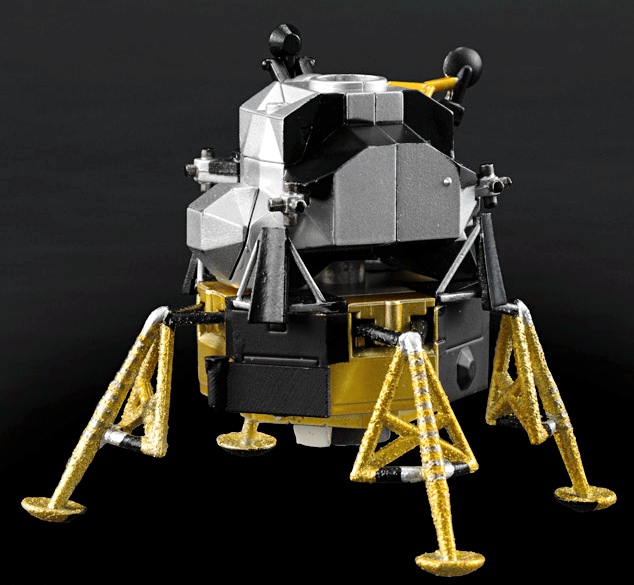
Forty two years ago today, Neil Armstrong and Buzz Aldrin landed on the Moon, while Michael Collins orbited high above in the Apollo Command Module. The Lunar Module (LM) was a four-legged aluminium-skinned contraption that was a true ‘space’ craft, designed for operation in a vacuum, with none of the smooth streamlined shape necessary for flight in a planetary atmosphere.

Apollo 11 models
There are various models available that commemorate the landing, including the 1:72 scale Airfix diorama kit that includes the LM, a neatly sculpted rectangle of cratered lunar terrain and logistics support in the form of surface instruments, a mixed bunch of astronauts, and Lunar Rovers. The terrain base is a good size, somewhat larger than an A4 sheet, at 348 mm (13.7 in) long x 247 mm (9.7 in). Cement, acrylic paints, and a brush are also included.


Extra astronauts supplied by Airfix
The Apollo 11 landing involved only Armstrong and Aldrin, so the supplied group of astronauts are there for creating a fictional ‘what-if?’ scene, though later missions carried a Lunar Rover, so this Airfix kit can also be used to depict more than the ‘One small step for Man’ flagged on the box-top.

Dreams of space exploration
Interestingly, two of the Airfix astronauts are using one-person flying platforms, which were definitely once part of NASA’s future vision, but which were never actually constructed. Still, we can all dream - I visualized a nuclear-powered Mars ship around this time, when I worked on The Observer Sunday newspaper. I worked on the concept with NASA rocketeers who really thought we could be walking on the Red Planet by 1980! Well, that particular dream vanished when Apollo and the NERVA nuclear rocket programs were cancelled; the rest is history, as is the Space Shuttle. 


A spacecraft called Apollo 27
The actual Moon missions never went beyond Apollo 17, but for a look at what Apollo 27 might have looked like, click here for a closer look at the fictional spacecraft from Pegasus Hobbies, in California. The tubby streamliner (shown above) seems to have been influenced more by old TV shows and 1950s sci-fi book jackets than a depiction of a possible ‘real-space’ solution, and it’s an exo-endo atmospheric design into the bargain, complete with bubble canopy. Still, I’m not complaining - it’s a fun design and is to 1:72 scale, so would look great standing next to the Airfix Apollo 11 lander.

Space Pod from ‘Lost in Space’
There’s a somewhat more realistic pod design that’s been around for a looong time, and that’s the angular Space Pod from the 1960s children’s TV show ‘Lost in Space’. The 1:24 model comes from Moebius Models, and features an opening hatch, so once again diorama possibilities spring to mind - and for this scale and subject you could add alien critters based on model dinosaurs, and tentacled plant-life for a true out-of-this-world display.

Visit Apollo 27 from Pegasus Hobbies here.

Visit the Space Pod at Moebius Models, here.

Various Apollo kits are available at decent discounts here.


Thursday, May 19, 2011

SHIZUOKA HOBBY SHOW 2011 STARS


SMN report
The Shizuoka ‘Hobby City’ Hobby Show finished earlier this week, and there were many reveals of tempting new stuff. However, yesterday’s look at the new Dragon Type 95 tank kit allowed us to focus on this Chinese company and its wide-ranging product list.

Fine detail from Dragon
Dragon has looked into various technologies for its new products, including slide moulds, which allow more accurate reproduction of fine detail than standard two-piece moulds. The technique works by creating injection moulds that have built-in moving sections, the ‘slide’ of the name. These are inserted into the mould to form components, then removed for extraction. 


Slide advantages
Slide-moulding has two main advantages - it helps increase overall accuracy, and reduces the parts-count by adding small details directly into place on bigger components. Items that benefit from the technique include intricate patterns, gratings, one-piece hulls, and turret interiors. The extra detail available also means that photo-etch parts are not needed as much, so it’s benefits all round, unless you have a particular yen for complexity and mixed-media construction.


At the Shizuoka Hobby Show
The Dragon stand was packed with interesting stuff, and we show some of these, courtesy Dragon. The J-20 Stealth Fighter is a neat 1:144 scale kit of China’s latest prototype, and we’ll be featuring this and some other stealth stuff in the near future. 


The Boeing 747 in classic 1970s Braniff Airways ‘Flying Colors’ markings is a Dragon Project Cutaway kit, and as devotees of see-inside art as well as see-through models, this 747 is high on our list of must-haves, as is the beautiful in-flight Apollo 11 Command/Service Module, attached to the Lunar Module. Note that there’s also a Tranquility Base pair too - you can see the two spacecraft plus circular lunar landscape plinth at right in the picture above.


World War II is still a huge draw to model makers, and Dragon is a strong contender in this field, with a full range of German AFVs to build. AFVs big and small are on offer, and at bottom left above, you can just see a neatly finished 1:72 scale Type 95 tank. Staying with World War II, the six-wheel Mercedes-Benz looks to be a winner when it’s released.


Many of these kits can be seen in the info-packed 2011 Dragon catalogue, which is well worth a close look. It's available here.

Visit the Shizuoka Hobby Show 2011 here.


Saturday, August 29, 2009

TAMIYA REISSUES APOLLO 1:70 SCALE APOLLO 11


A MAT IRVINE REVIEW
The 40th anniversary of Apollo 11 has bought reissues of many original Apollo-era kits, and the latest is the first-ever reissue by Japan’s best-known model name, Tamiya.

In 1969, Tamiya issued three kits of the Apollo spacecraft. These consisted of a CSM Command/Service Module (kit number A-101), the LM Lunar Module (A-102), and a third kit (A-103) that featured these two combined. The bonus with A-103 was that you also got the SLA Spacecraft/Lunar Module Adaptor, which was a conical section that contained the LM during launch.

Tamiya’s 2009 reissue is of kit A-103, and you get two versions of the SLA - one in white plastic, one in clear. There are also two separate bases, one for the CSM-SLA, the other for the LM on the Moon, with two astronauts that came with the original LM kit, A-102.

However, what you don’t get this time around is one of those gimmicks that the Japanese kit industry delighted in, especially in earlier years - the CSM in kit A-103 was motorized, and you could fly it round the room! A small electric motor was tucked inside the Service Module, and a two-bladed propeller stuck out the back of the engine bell. You hung the spacecraft from the ceiling on a nylon line, and watched it circle around! Many of the action parts are still included in the box, but there is no motor, switch assembly or propeller.

A copy of the original plans are supplied in Japanese, but - if your Japanese is not up to scratch - you get a new English supplement that takes you through the various construction stages. This also explains the business of the original motorization, and the fact that it’s no longer in the kit.

Also included this time around is a sheet of gold foil, and a clear sheet for the small windows in both the CM and LM. Some parts are also still chrome plated, which may seem odd, but these are mostly for the LM legs and struts, a number of which were covered in silver foil, so the chrome could be left ‘as is’ to simulate this.

The kit is to the slightly odd 1:70 scale, as it comes from a time when many Tamiya kits were in metric, not imperial, scales. But of course, it is very close to 1:72, the same scale as the Airfix LM and a great deal else besides. Perhaps odder though, is that Tamiya has made so few factual, real-space kits. Besides this, the only other space item has been the 1:100 scale Space Shuttle Orbiter.

The photos show, top to bottom:
* Original 1969 boxes for the separately-issued Apollo craft.
* The new box with 40th anniversary label.
* Contents of the new box - the red parts are a somewhat odd shade for the LM pads and Descent Stage engine bell, but are the same as they were back in 1969.

Thanks to The Hobby Company, which supplied the review kit and which distributes Tamiya in the UK.

Visit THC here.

The kit is available from retail stores and suppliers online, including eModels here.

Monday, August 24, 2009

A NEW LOOK FOR THE AIRFIX LUNAR MODULE KIT


A MAT IRVINE REVIEW
When asked by Airfix if I would take a look at two potential reissues to celebrate the Apollo 11 40th anniversary, I knew there were some changes that were going to have to be made. First, the Saturn V had to have its Service Module corrected, which was done, and which I covered in a previous posting. Second, the 1:72 scale Lunar Module (LM) needed looking at.

You can be picky and say some details on the Airfix LM are not quite right, but overall it is actually pretty accurate. However, one aspect needing a change was the supplied colour scheme. When the Lunar Module was first announced (originally it was called the ‘Lunar Excursion Module’, but NASA reputedly dropped the ‘Excursion’ as it sounded a bit like a vacation, though the pronunciation ‘lem’ remained) it was usually seen in a black and white finish. However, this was only for early non-final ‘boilerplate’ versions, but the colour scheme got through to the early Airfix artwork and this has never been changed, until now.

So my main task was to ensure that the new colour instructions were closer to the actual scheme of the flightworthy LM, given the limitation that this is a kit aimed at the general model-maker. With designer Jonathan Mock doing excellent graphics and a new decal sheet, you now have a colour plan that uses black, gold, aluminium and silver - and if these aren't absolutely every single shade seen on the real craft, they're much closer than plain ‘black and white’.

And that’s not all with this new Airfix kit. You also get the Astronaut Set included, which conveniently provides two Lunar Rovers (for Apollo 15 through 17) and other astronauts in alternative poses. The only brand-new part is an extra vacuumed-formed base that can incorporate not only the LM, but as many astronauts and equipment as you like. It's a good size, measuring some 347 x 246 mm (13.6 x 9.7 in). A last-minute decision by Airfix was to include a sheet of gold foil, to cover appropriate areas on the LM Descent Stage.

The pictures show the new box-art (top), another first for this kit, which has always used a variation of the original painting. The back (middle) has neat renderings of what’s in the box, including the astronauts, which were rapidly built by me!

The box contents (bottom) include a separately packed LM and its two astronaut figures, all moulded in polystyrene. The astronauts are polyethylene, a material that does not take enamel paint or conventional plastic cement, but you can use superglue and acrylic paints. As Airfix designates the kit as a ‘set’, eight small pots of acrylic paints are supplied, along with paint brushes and cement.

And finally - if you want to add more detail, the plans include the address for Mike Mackowski’s excellent Space in Miniature website. His book SIM 7 Apollo Lunar Module is packed with information.

Visit Airfix here.

Visit Space in Miniature here.

Wednesday, August 19, 2009

GLENCOE EXPLORER SATELLITE MODEL MARKS 50 YEARS OF AMERICAN SPACEFLIGHT


A MAT IRVINE REVIEW
One space anniversary that seemed to get lost in the build-up to this July’s Apollo 11 40th was last year’s 50th anniversary of America in space. Explorer 1 became the first US satellite when it was successfully launched into orbit on February 1, 1958, by a US Army Jupiter-C rocket, modified for the flight to become the Juno-1.

A 1:6 scale model of Explorer 1 was produced by the Ideal Toy Company (ITC) in 1959, only a year after launch, and this was quite a detailed kit. It not only had an opening outer casing to show off the interior, but sat on a stand that had a handle (top picture). Turn the handle and, via what was in effect an all-plastic musical box, it ‘clicked’ out the telemetry signal the satellite sent back! 

The kit became quite rare, but those who wanted to actually build the model (instead of using it as loft insulation) were saved when Glencoe Models came on the scene. Founded and managed by Nick Argento, Glencoe reissues many of these old ‘collectible’ kits in a way you can actually build them – and the ITC Explorer 1 (middle picture) is one of these. The first Glencoe Explorer 1 was available in 1991, and it was reissued again last year as an Anniversary Edition, with additional information on the back of the box (bottom), as well as the original Glencoe artwork on the front.

The Explorer 1 Jupiter-C launch rocket (an ex-Hawk kit) is also available as a 1:48 scale kit from Glencoe.

Visit Glencoe Models temporary site here.

Sunday, August 9, 2009

FIRST LIGHT - LOOKING AT NEW PARTS FOR THE AIRFIX SATURN V REISSUE


A MAT IRVINE REVIEW
About mid-August you should be able to buy the reissued Airfix Apollo Saturn V kit. You’ll immediately note that there is new box-art, showing the huge rocket heading for orbit. However, what may not be apparent is that this issue now has the upper - Apollo - sections corrected. All previous issues (and the kit was first issued 40 years ago, in 1969) have been incorrect.

It was wrong in two aspects. Firstly, the Service Module (SM) - the cylindrical part below the conical crew-carrying Command Module (CM) - was too thin. Consequently, this affected the Boost Protective Cover (BPC) that covered the CM at launch, and the Spacecraft Lunar Module Adaptor (SLA) that housed the Lunar Module (LM). The height of the SM was correct, but the diameter was too small.

Secondly, the Service Module had the wrong radiator pattern. It showed a Block I pattern, which was correct for uncrewed flights, but all manned flights used a Block II SM, with a different radiator pattern. Airfix was not the only company guilty of this - Saturn V rocket kits from Monogram, Revell and AMT also had the Block I pattern.

The only kit from a mainstream manufacturer, (as against a ‘garage’ or specialist), with the Block II was the 1:32 scale Monogram Command Service Module (CSM). This has been recently reissued by both Revell US and Revell Germany - see SMN’s previous post on this subject.

But now you can add the Airfix kit to the ‘got it almost right’ list, even if corrections have waited until the 40th anniversary of Apollo 11. There are nine newly-tooled parts: the SM is new, and this has entailed new bulkheads, SLA and BPC. Just one niggle though - the Command Module has not been re-tooled, so its diameter is still too small, but frankly, you can’t see it anyway when the BPC is in place.

The pictures show the attractive new box-art (top), the assembled rocket (middle) and note here that the original rectangular base has returned. The bottom picture shows the new-tool Apollo parts (far right) compared to the old.

Visit Airfix here.

Thursday, July 30, 2009

HISS BOO! LUCASFILM PUTS A STOP TO STAR WARS KITS FROM FANTASTIC PLASTIC


Sadly, the movie studio LucasFilm chose the 40th anniversary of the Apollo 11 Moon landing to order Fantastic Plastic to stop marketing its excellent Star Wars kits.

In FP’s words: “On July 20, 2009, Fantastic Plastic received a "Cease & Desist" order from LucasFilm demanding the removal of all unlicensed products from our Website.  In compliance, we have retired all "Star Wars"-related kits to the Virtual Museum Store “Hall of Fame”. We will no longer market or sell these or any other kits that fall under LucasFilm's jurisdiction.”

SMN’s not going to preach about the rights or wrongs of the situation, but we will say it’s a shame that Fantastic Plastic’s Allen Ury and LucasFilm couldn’t come to an amicable arrangement, especially as the range included fascinating kits, such as the 1:72 scale Incom Skyhopper (top pictures) and 1:144 Jawa Sandcrawler (bottom. Hey ho, looks like we’ll all have to bombard Revell with requests for new subjects to release.

On a brighter note, Fantastic Plastic's range blossoms otherwise, and its latest offering is another sci-fi movie subject, a 1:48 scale Bubble Fighter from the movie Lost in Space. The movie was not so hot in the acting department (and may have marked the nadir of Matt LeBlanc’s career) but the special effects were pretty good and the spacecraft designs excellent. So this big kit - standing more than 305 mm (12 in) high - should be on any sci-fi modeller’s wish list.

Visit LucasFilm here, and Fantastic Plastic here.

Tuesday, July 21, 2009

MAT IRVINE'S 'LOST IN SPACE' CHARIOT MODEL ON SHOW AT SPACEPORT


Mat Irvine worked for several months on the Spaceport project, a space-themed visitor exhibition just across the River Mersey from Liverpool, UK, home of the famed Beatles. One of Mat's exhibits is the made-up Moebius Models Chariot from Lost in Space, shown above.

Spaceport looks well worth a visit, as it includes a planetarium show, and - from July 28 to September 3 - some Moon rock samples collected on the Apollo missions 15, 16 and 17.

Visit Spaceport here.

APOLLO 11 - TAMIYA 1:70 SCALE RE-RELEASE


This Tamiya rerelease has an excellent IWOOT factor, apart from its rather exotic 1:70 scale. Still, it can sit next to a bunch of 1:72 scale models without too many misgivings.

The kit is unusual for including the Lunar Module’s Saturn V container section, and things get better - the Command/Service Module has a swing-out section that reveals neat interior detail, there are two display bases, and gold foil is included for the LM’s insulation blanket. The LM itself separates into two sections, allowing the Ascent Stage to be docked with the Command Module.

Two astronaut figures - Neil Armstrong and Buzz Aldrin - and a US flag complete the mini-diorama lunar surface. Very nice too, Tamiya - it’s just a pity this very complete model hasn’t been available for so long.

Monday, July 20, 2009

LUNAR MODULES - APOLLO REALITY AND TV FANTASY


Forty years ago today, Neil Armstrong and Buzz Aldrin landed on the Moon, while Michael Collins orbited high above in the Apollo Command Module. The Lunar Module (LM) was a fragile aluminium-skinned bug-like contraption that was a true spacecraft, designed for operation in a vacuum with none of the smooth streamlined shape necessary for flying in a planetary atmosphere.

There are various models available for the LM, including Revell’s excellent 78-part 1:48 scale LM and diorama that we’ve shown here before. But there’s also another landing module available, a design that echoes the flavour of the real thing, even down to its insectoid triangular windows, and that’s the Space Pod from the third and last series of the 1960s TV show Lost in Space.

The Space Pod (top picture) comes in big 1:24 scale from Moebius Models, a company that also makes the Lost in Space Chariot ground vehicle to the same scale (bottom). The Moebius Space Pod features an opening hatch, so the possibilities for a diorama open up for spacesuited figures stepping out onto a cratered landscape under the landing pads - or, since it’s a science fiction subject, you could add some colour and even exotic alien lifeforms to add some visual spice.

You can visit the Space Pod at Moebius Models, here.