Passion for Precision

Showing posts with label AFV. Show all posts

Wednesday, November 16, 2011

RENWAL’S LARGEST MILITARY KIT - THE US ARMY M65 ATOMIC CANNON


From Mat Irvine:
Revell has owned most of the old Renwal company’s moulds for decades - actually, since 1976 - and has reissued many of those kits. So far, these have been released in Revell boxes, but now, thanks to Product Manager Ed Sexton, the original distinctive Renwal box-art has been reintroduced, including the Renwal name.

Blueprinter series
One thing Ed liked about the original art is that Renwal issued military kits in its ‘Blueprinter’ series, as the company maintained proudly that such models were designed: “from original blueprints”. To this end, the boxes featured a distinctive blue-chequer design - OK maybe not a real blueprint, but it looked good! 


Bill Lastovich (left) and Ed Sexton of Revell-Monogram.
Mobile artillery
In 2010, Revell reissued the 138-part Renwal 1:32 scale Big Shot self-propelled howitzer, complete with six-man combat crew and working features. Now it’s the turn of an even bigger kit, the Renwal M65 Atomic Cannon. The original mobile artillery piece was enormous at 25.6 m (84 ft) total length, and the Renwal 1:32 scale kit is equally impressive, at 851 mm (33.5 in) long. Seven crew are included in the box - a US Army gun crew could deploy the massive weapon in just seven minutes.  The moulding colour is light grey, (the original was army-issue olive drab), and the parts count is still over 300. You get the cannon, plus the two tractor units, one at each end. 


More than 300 components fill the Atomic Cannon's sturdy box.

No cement visible
Renwal made great play on the fact that cement join lines were hidden from view - it was termed ‘No Show’ - and as was typical for kits of that period, there many working parts were designed into the kit. The gun itself elevates, recoils, and when placed ‘on the ground’, can be rotated. The tractors come with rotating wheels, and the ability to attach and detach the cannon from cradles. However, these cradles should not stay with the cannon. This was an error made in the early-1980s Revell ‘History Makers’ reissue, where the box photo showed this incorrect scenario. 


The 1983 History Makers issue shows incorrectly-placed cradles, still attached to the gun.


Big Shot howitzer, reissued in 2010.

Box talk
Talking of boxes, unlike that of the Big Shot howitzer, this one isn’t identical to the original. Ed Sexton admits he thought the original lettering was a bit understated, so it is now bigger and more distinctive, being set centre-stage on a box that is a different ratio to the original.

Not quite the biggest kit
Big as it is, the Renwal Atomic Cannon is not the largest kit ever made - it isn’t even Renwal’s largest kit  (see link below) but it remained supreme in scale military vehicles, really until the 1:35 scale Dora rail gun came along. All in all though, the Revell-Renwal Atomic Cannon is a terrific piece of scale model technology, and should be in every AFV fans collection. 


Atomic Cannon on display at the Aberdeen Proving Grounds.


The real thing
The last of the 20-plus M65 Atomic Cannon constructed left military service in 1963, though one was used at the Nevada Test Site on May 25, 1953, the only time the M65 actually fired a nuclear shell, a 15-kiloton device that was lobbed 11 km (7 miles) in a test-firing code-named 'Grable'.


Atomic Cannon today
Eight M65s still survive, displayed at various US museums, though only the one pictured, at the Aberdeen Proving Grounds, Maryland, still has its tractors attached. Note that this site is currently under review, and at some point the exhibits may be moved to a new museum being created at Fort Lee, Virginia.

SMN ‘biggest kit’ article here.

Thanks for information to Ed Sexton and Bill Lastovich at Revell-Monogram LLC.   

Wednesday, May 18, 2011

SMALL BUT PERFECTLY FORMED - 1:72 SCALE HA-GO LIGHT TANK FROM DRAGON


SMN report
The Chinese model company Dragon continues to add subjects to its wide-ranging list of AFV kits. This time, it’s a ‘model aircraft’ 1:72 scale Type 95 Ha-Go light tank, as manufactured by Mitsubishi and used in the 1942 Philippines campaign.


Type 95 tank, preserved at the US Army Ordnance Museum.


The Type 95 tank
The 4.38 m (14.4 ft) long Type 95 was the most common light tank used by the Imperial Japanese Army (IJA), with some 2300 manufactured in all, production starting in 1935. It had been designed as support for advancing infantry, and although lightly armoured, Japanese commanders reckoned its speed - up to 45 km/h (28 mph) on a decent surface - and design flexibility made up for this. The Type 95 weighed just 7.4 tonnes, had a crew of three, with a 37mm main gun. 


Dragon cgi images show neat detailing for production kits.

What’s in the box?
AFVs at 1:72 scale are tiny jewels indeed, and the Dragon Type 95 is no exception. However, that’s no bad thing, as the model is packed with fine detail, with special moulding techniques being used to produce various components. These include the turret and cupola which are single-piece units, with slide-moulding enabling detail elements to be correctly rendered.


Neat touches
The upper and lower hull sections are also one-piece components, featuring armour panels, bolts, and other details. A neat thought from the Dragon engineers is the gun barrel, which has a hollow muzzle - which means no more twirling a scalpel blade to add a touch of realism! Dragon claims high realism for the track and suspension, too.


The Dragon Type 95 is due shortly; meantime other Dragon AFVs are here.

Pictures of the preserved Type 95 courtesy Mark Pellegrini, taken at the US Army Ordnance Museum, Aberdeen Proving Ground, Maryland.


Friday, March 4, 2011

SUPER PERSHING - THE FIRST ALLIED TANK TO BEAT THE GERMAN KING TIGER


SMN report on the Tamiya T26-E4
As World War II was drawing to an end, the M26 Pershing was coming into service in Europe, and was the first US tank that could take on powerful German armour such as the Tiger I and Panther on reasonably even terms. Tamiya’s 1:35 scale kit represents the T26-E4, a developed version of the Pershing, armed with a long-barrel 90mm main gun with enough power to throw armour-piercing shells punching through the front plate of even the ultimate German tank, the King Tiger.


What’s in the box?
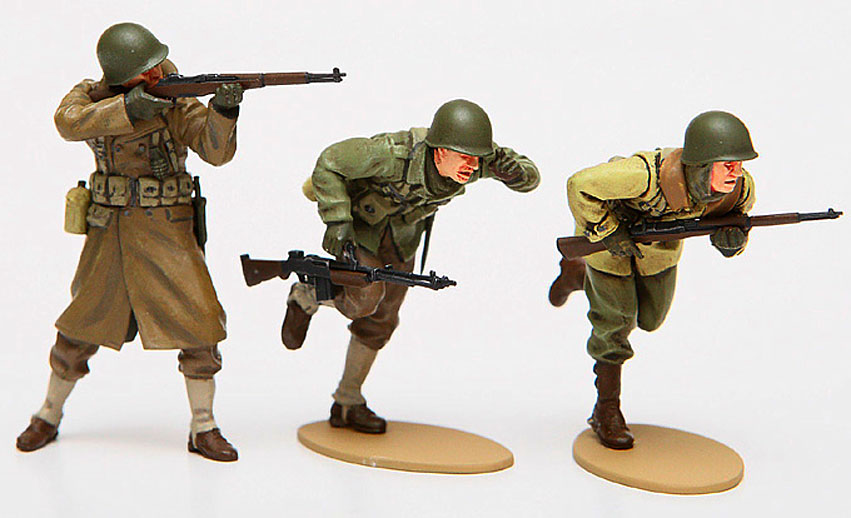
This 1:35 scale kit is well up to the standard set by Tamiya over the years, and when assembled has a length of 293 mm (11.5 in) and width of 101 mm (3.98 in). There’s a nice suspension setup that allows the road wheels and tracks to follow terrain contours - a good detail if you like putting scale armour into dioramas; few things spoil a display quicker than straight tracks over bumpy ground. Various parts and accessories are included, including the T26-E4’s turret counterweight, as well as neatly moulded ammo cases, and a set of very convincing figures - three infantrymen and two crew, though the latter each exist only as a legless torso - there's no room for legs in this tank model! 


Farewell Super Pershing
The tank was not widely produced: although 1000-plus were planned, World War II came to an end before the production run got properly underway, and the order was cancelled. Even so, many design elements were incorporated into tanks that saw service in later years.


SMN score
Another superior tank kit from Tamiya, and an unusual choice into the bargain. Should be an addition to any committed AFV model maker's collection.

Tamiya Super Pershing will be available soon; meantime there's a Hobby Boss version here.

Pix courtesy Tamiya, SMN studio.


Saturday, August 28, 2010

RUSSIAN 1:35 SCALE BT-7 TANK FROM TAMIYA


SMN report
Russian BT tanks (from the words Bystrokhodny Tank, meaning ‘fast tank’, leading to the nickname ‘Betka’) were produced from 1932 to 1941. They were lightly armoured, but had a powerful main gun, decent speed, and fair mobility. The sloping front armour was a major protective innovation, and was a feature that would be incorporated into many later tanks, including the famed T-34.

Combat career
Early BTs first saw combat in the Spanish Civil War, but in the World War II tank battles of 1940 and 1941, German armour was massively superior. The bottom picture shows just one of the thousands of BT tanks that were destroyed or abandoned in the face of overwhelming firepower.

What’s in the Tamiya BT-7 kit?
It’s the 14-tonne BT-7 that is the subject of this beautifully crafted 1:35 scale Tamiya kit. When assembled, Tamiya’s model has a length of 161 mm (6.3 in) and includes a pair of figures, commander and crewman. A pity another figure wasn’t included though, as the BT-7 normally had a crew of three.

Metal parts
Engine cover and radiators are well served however, as these are photo-etched parts, with all the fine precision this implies. Another metal component is the tow chain dangling between the headlights, two items which feature clear lens covers. Markings for five different vehicles are included, and the first BT-7 kit production run also has a nicely-printed photo leaflet included which provides useful photo references. All in all, the BT-7 is well up to the usual high standards for 1:35 scale military subjects from Tamiya.

See the Tamiya BT-7 kit here.

View oodles of Tamiya militaria here (we want the lot, but there’s not enough room at SMN Towers, sad to say).

The pictures show, top to bottom:
1-2  BT-7 boxtop art, and three-view diagram
3-5  Views of the completed Tamiya BT-7.
6  BT-7 tank destroyed in action by German forces, July 1941.
Pictures courtesy German Federal Archive, Tamiya.